Research Support Fund

The Research Support Fund (RSF) is an annual grant that helps defray some of the administrative costs associated with federally-funded research.
This fund assists Canadian post-secondary institutions with the costs associated with managing their research enterprise, helping them to maintain a world-class research environment.
The RSF is a joint initiative of these organizations


Indirect costs of research
Research funding provided by granting agencies is generally limited to direct project costs (research equipment, salaries of research assistants, etc.). Institutions whose researchers receive research funding also incur costs in managing their research enterprise. These are often referred to as the indirect costs of research.

Distribution of the Research Support Fund
The allocation from the Fonds de soutien à la recherche de l'Université de Montréal is calculated on the basis of funding granted over the previous three years by the three Councils (CIHR, NSERC and SSHRC).
(Please note that the graphics in this section are in French)
Financial year 2024-2025
The government uses data for fiscal years 2019-2020, 2020-2021 and 2021-2022, 2022-23, 2023-24, and the sum of funding used to calculate indirect research costs averages $103M annually for UdeM. The amount paid by the RSF represents a contribution of nearly 16% of this funding, and supports other internal and external sources of funding for the general research activities of the Université de Montréal, the largest French-language research university in North America.
For fiscal 2024-2025, UdeM and its affiliated institutions will share a grant of $16,181,615.00 (excluding additional project grants):
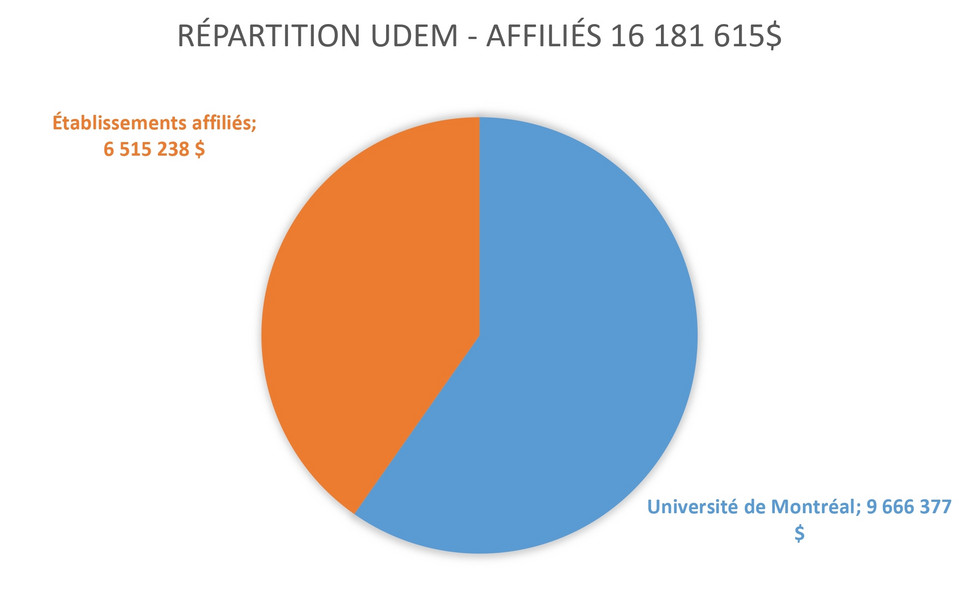
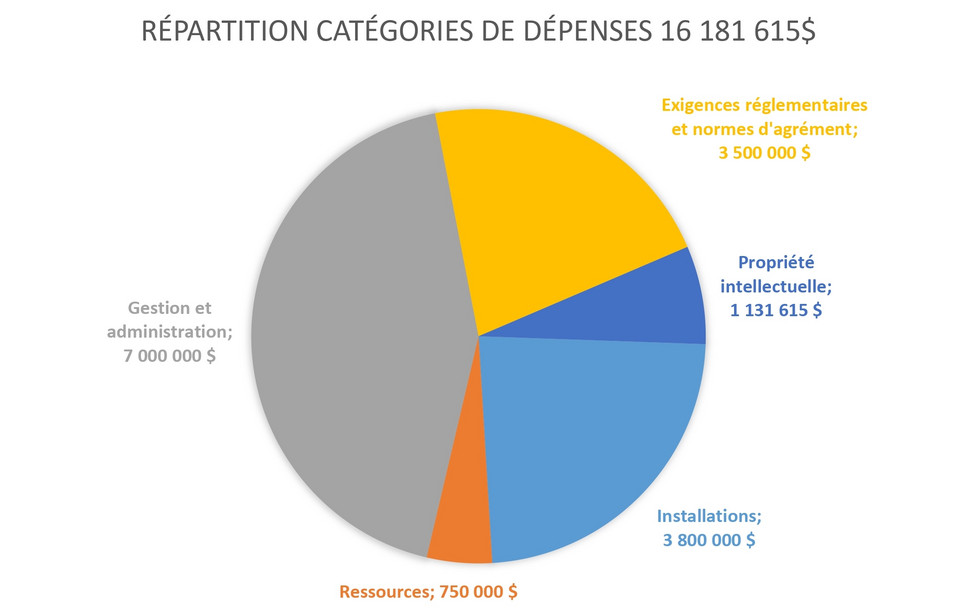
These funds are used for 5 main categories of expenditure:
- Facilities: renovation, maintenance and operation of research facilities (heating, air conditioning, etc.),
- Resources: acquisition of journals, books and periodicals, access to library collections for research staff, both on campus and in affiliated centers, and enhancement of computer resources for research (database and grant management systems).
- Management and administration: administrative support for obtaining research funds and administering grants, including resources from finance, HR, purchasing and the research office).
- Regulatory requirements and accreditation standards: animal ethics and deontology committees, technical support for animal care and health and safety in laboratories.
- Intellectual property and knowledge mobilization: support for the valorization of research results and knowledge transfer activities.
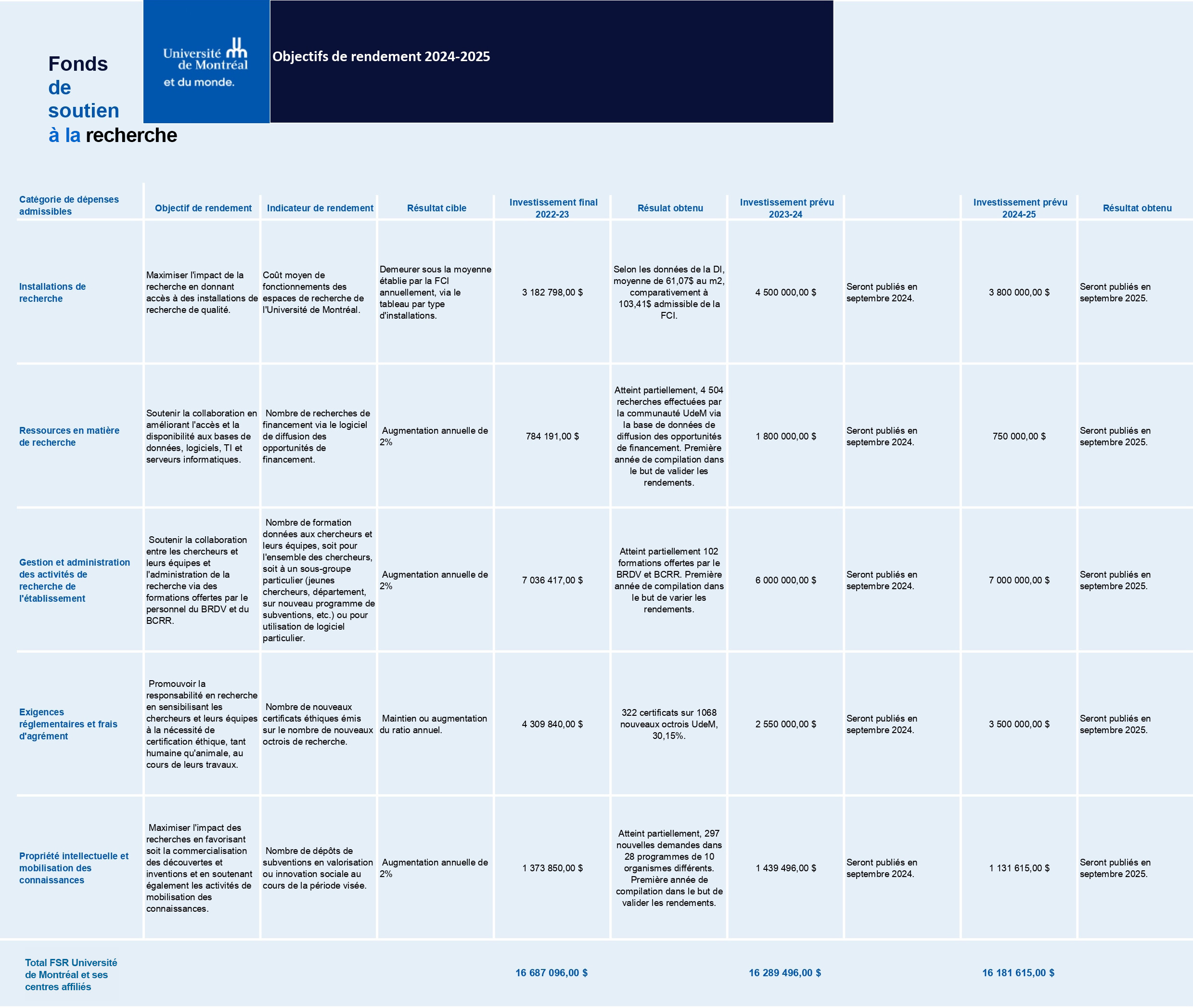
Performance targets for 2024-2025
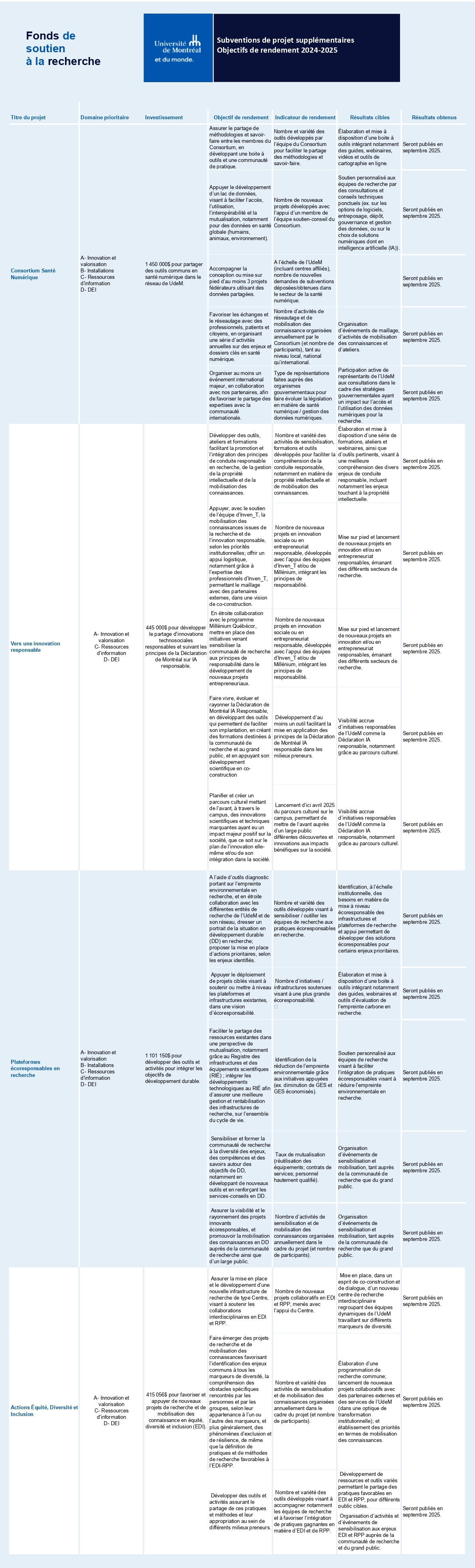
In line with the new Research, Discovery, Creation and Innovation Action Plan 2022-2027, Université de Montréal has revised its RSF performance objectives to align them with the action priorities of the Vice-Rector for Research:
- Supporting collaboration
- Promoting responsibility in research
- Maximizing the impact
Previous and planned uses in 2024-2025
The Government of Canada's Research Support Fund(RSF) is designed to help post-secondary educational institutions, as well as their affiliated hospitals and research institutes, cover the expenses incurred in managing research funded by the three federal granting agencies:
- Canadian Institutes of Health Research (CIHR);
- Natural Sciences and Engineering Research Council (NSERC);
- Social Sciences and Humanities Research Council (SSHRC).
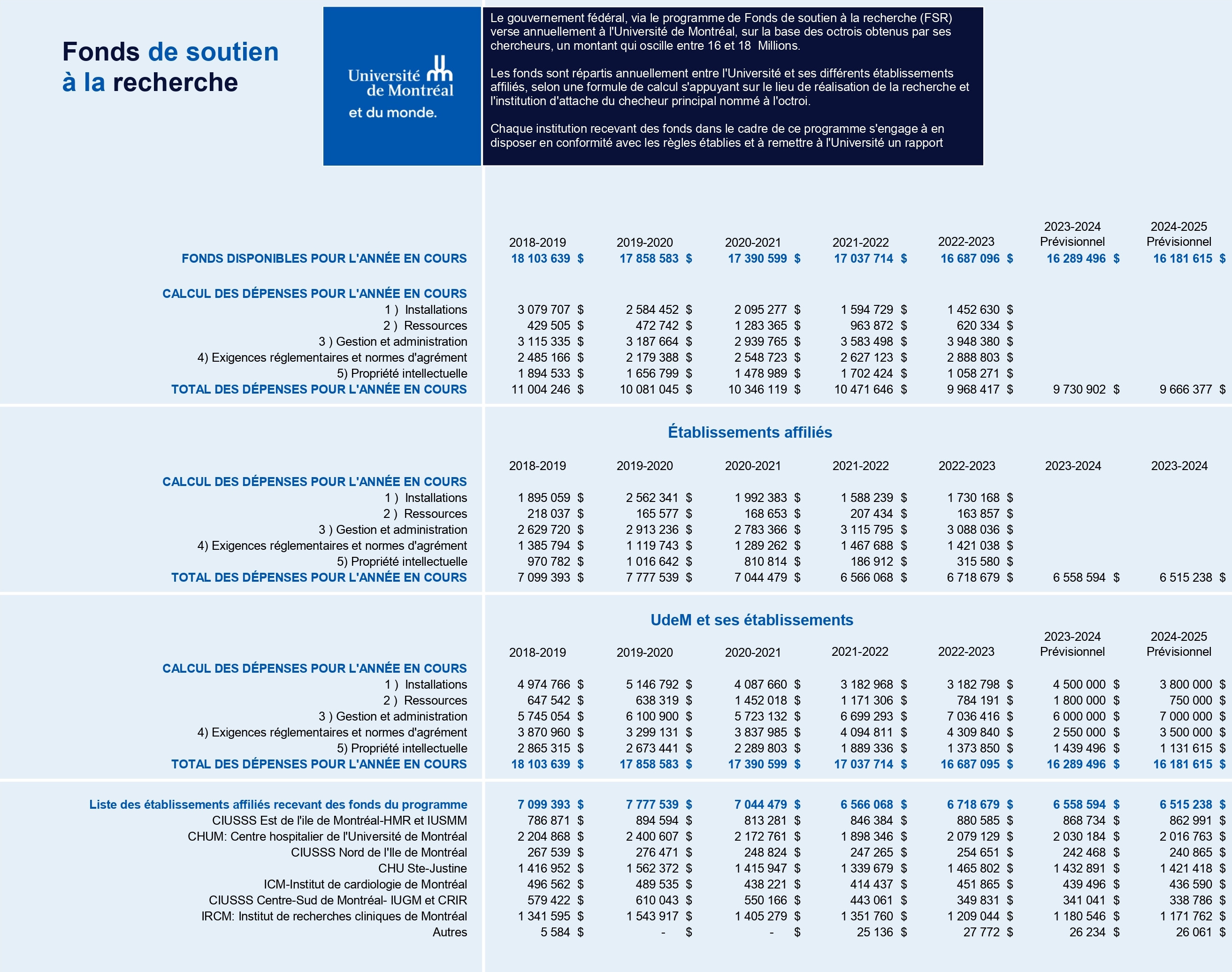
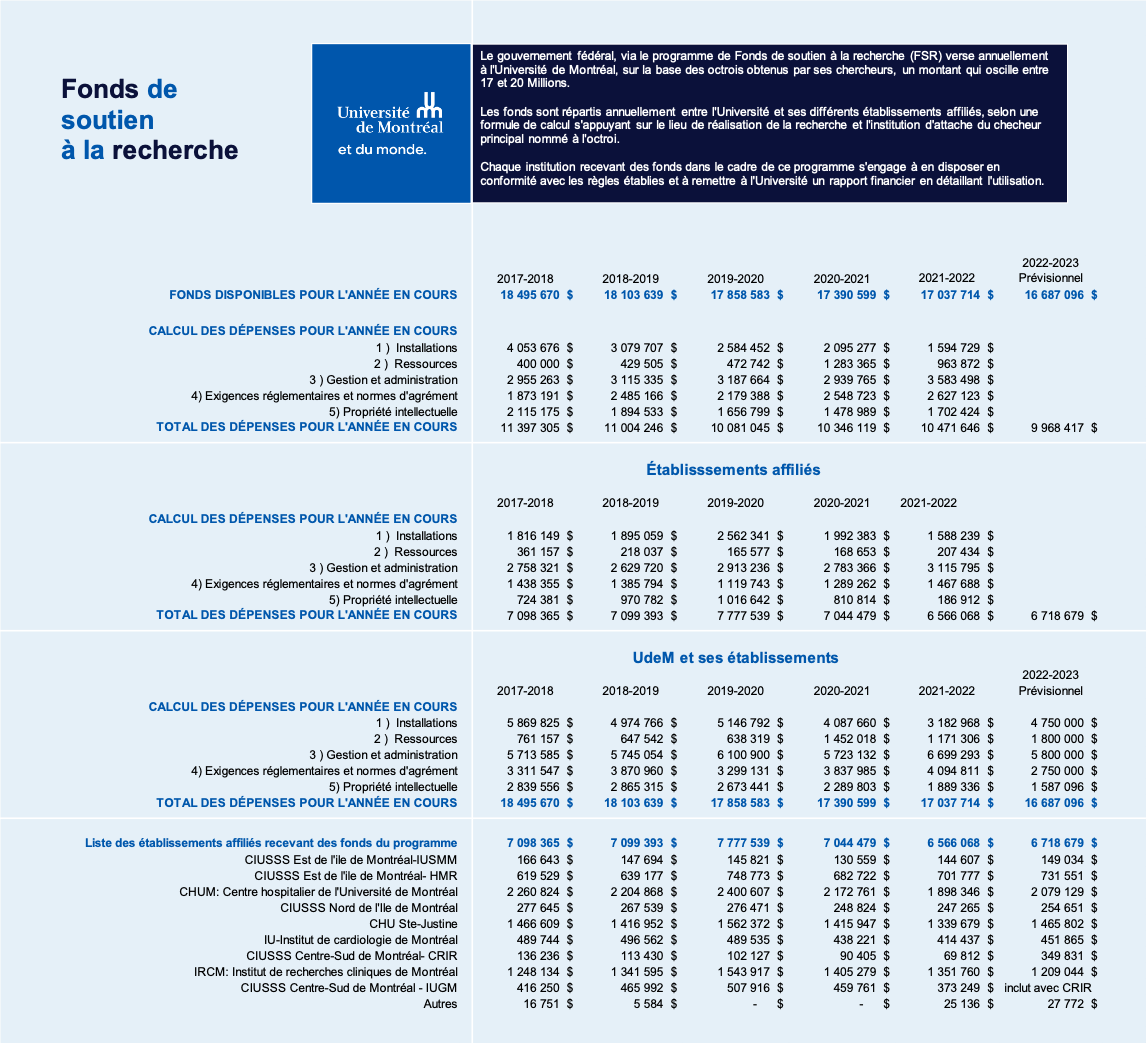
Under the affiliation agreements, which are still in effect, the federal government's share of indirect costs is calculated on an annual basis. A significant part of UdeM's research takes place in its affiliated hospitals, which is why they receive around $7 million annually from the Research Support Fund.
Expenditures in recent years are shown in the following table:
Consult previous uses : 2022-23
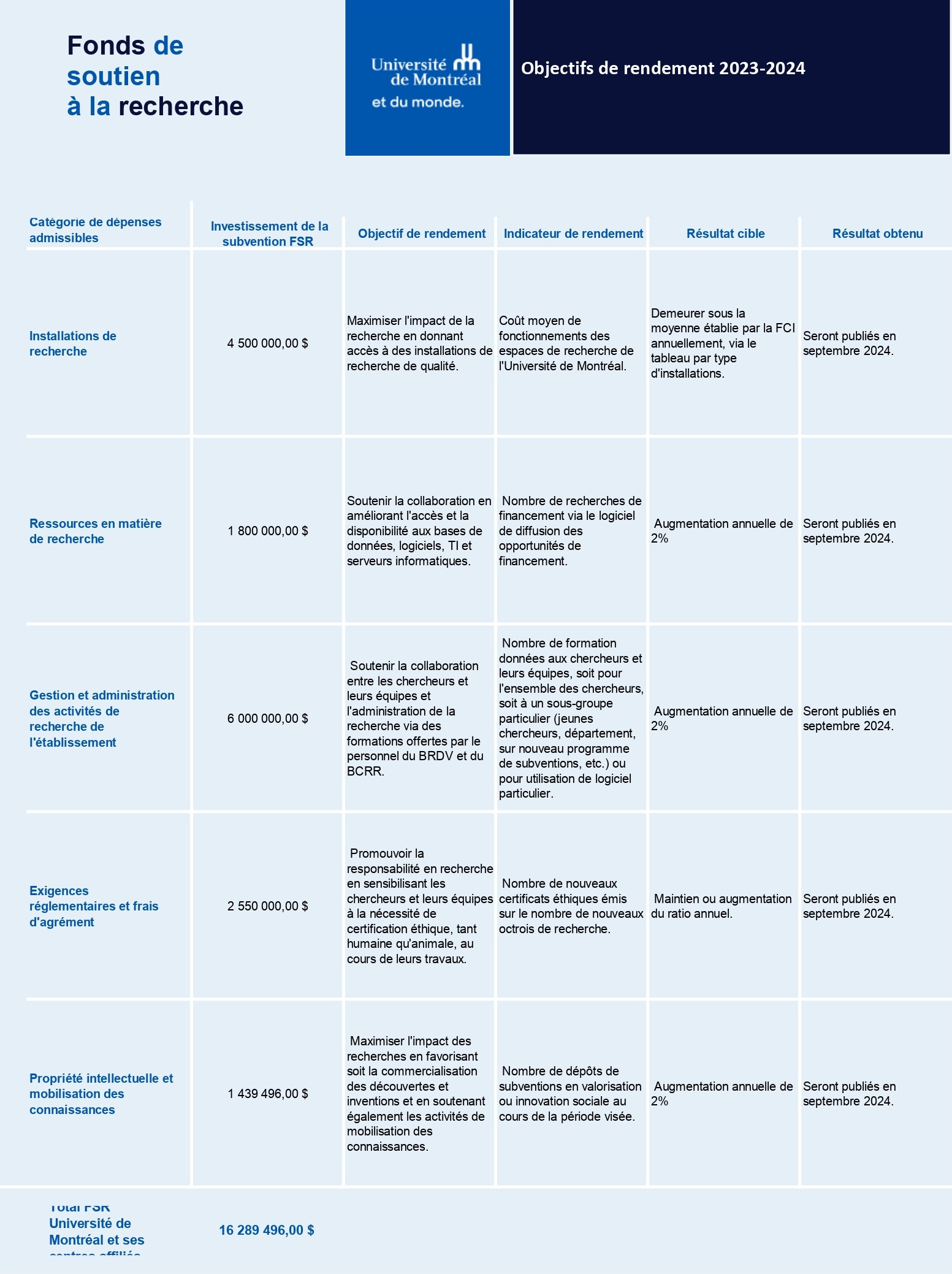
2023-2024 Performance targets
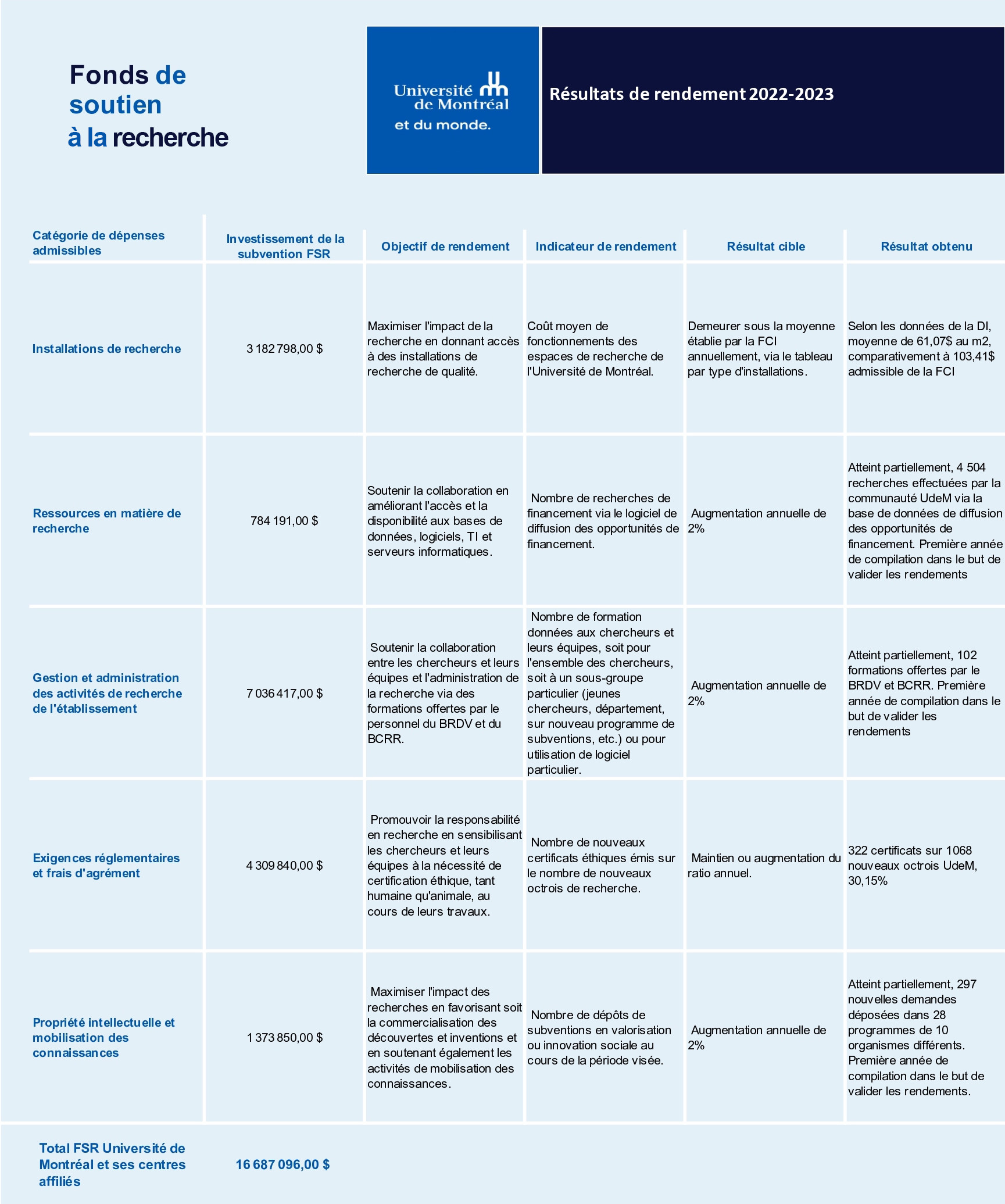
2022-2023 Results and performance targets
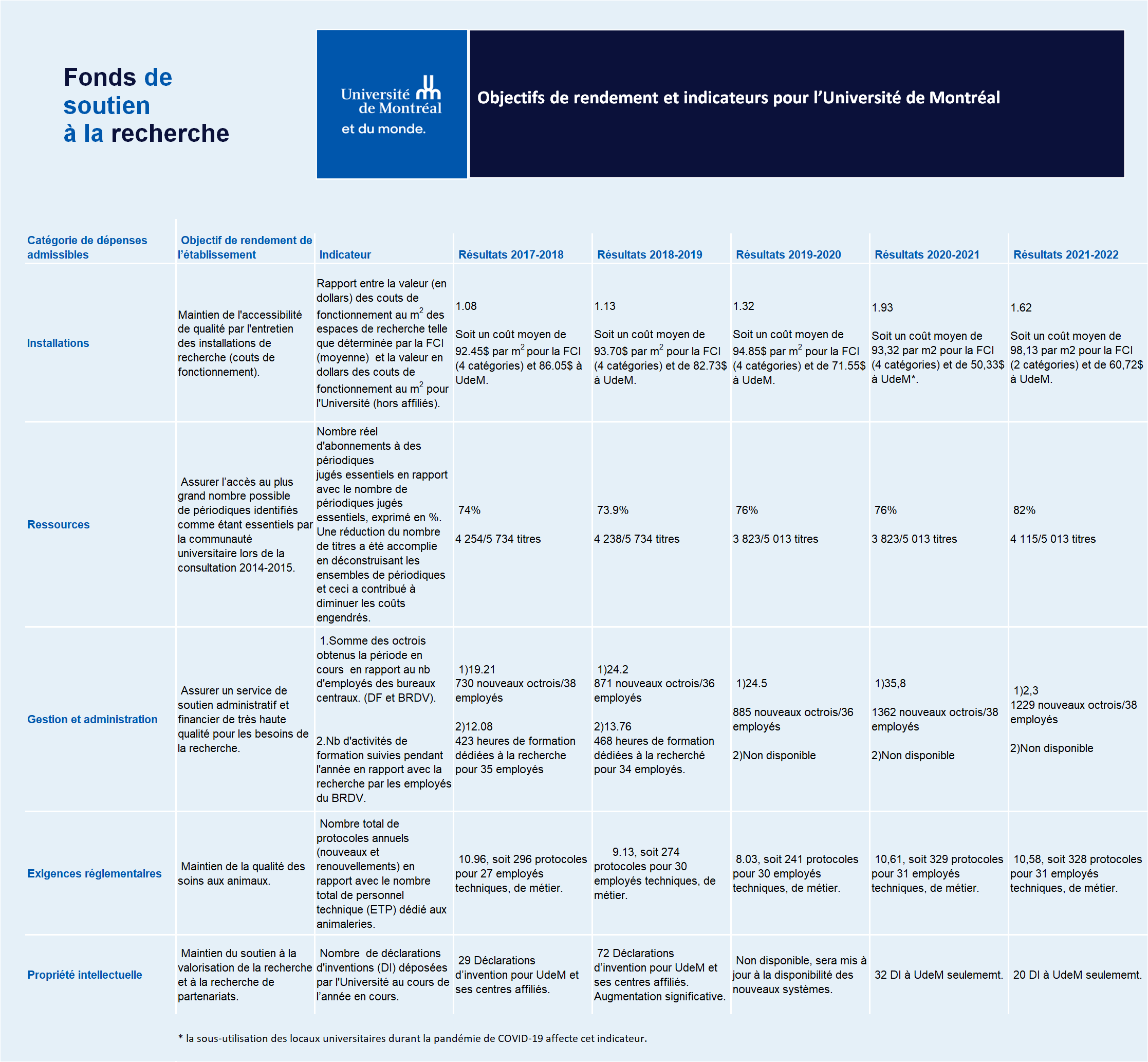
2021-2022 and earlier performance targets
 |
Partner institutions
Université de Montréal relies on a broad network of affiliated schools, university hospitals, university-affiliated centers and university institutes to cover the entire spectrum of current knowledge and encourage research, whether fundamental, clinical, applied, evaluative or interdisciplinary.
Consult the complete list of affiliated establishments (in French)

Incremental Project Grants
Since 2018-2019, the Canadian government also funds the Incremental Project Grants (IPG) program and allows UdeM and its affiliated institutions to receive money for specific activities. These funds must be invested in priority areas targeted by the government:
- innovation and commercialization activities,
- facility refurbishment, including deferred maintenance,
- information resources, including digital resources, open access and databases,
- equity, diversity and faculty renewal (in the context of increasing equity, diversity and inclusion).
(Please note that the graphics in this section are in French)
Financial year 2024-2025
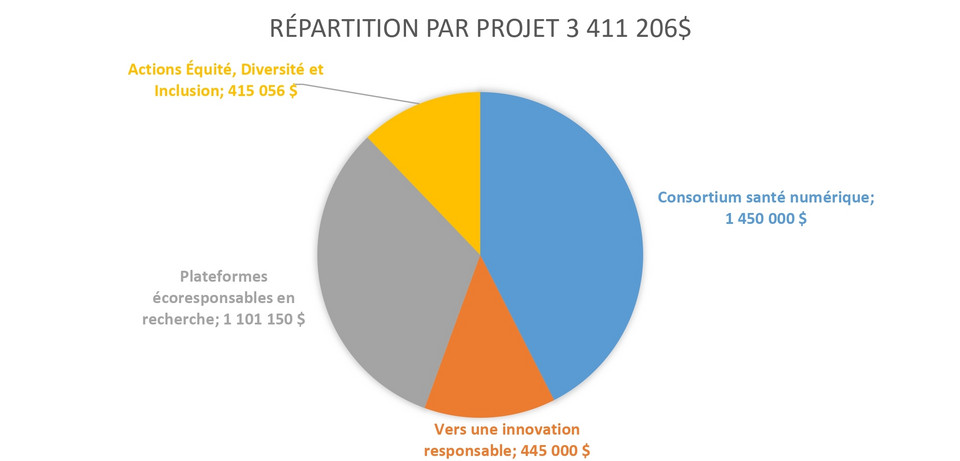
For fiscal year 2024-2025, UdeM and its affiliated institutions will share $3,411,206 from the Incremental Project Grants program.

Performance targets for 2024-2025
Previous and planned uses in 2024-2025

2023-2024 Performance targets

2023-2024 Results and performance targets
Consortium Santé Numérique : Strengthening support for the management and enhancement of healthcare data

Vers une innnovation responsable : Support the deployment of initiatives integrating responsibility

Plateformes écoresponsables en recherche: Reducing the environmental impact of research activities

Actions Équité, Diversité et Inclusion : Promoting dialogue, reciprocity and favorable practices

2021-2022 and earlier results
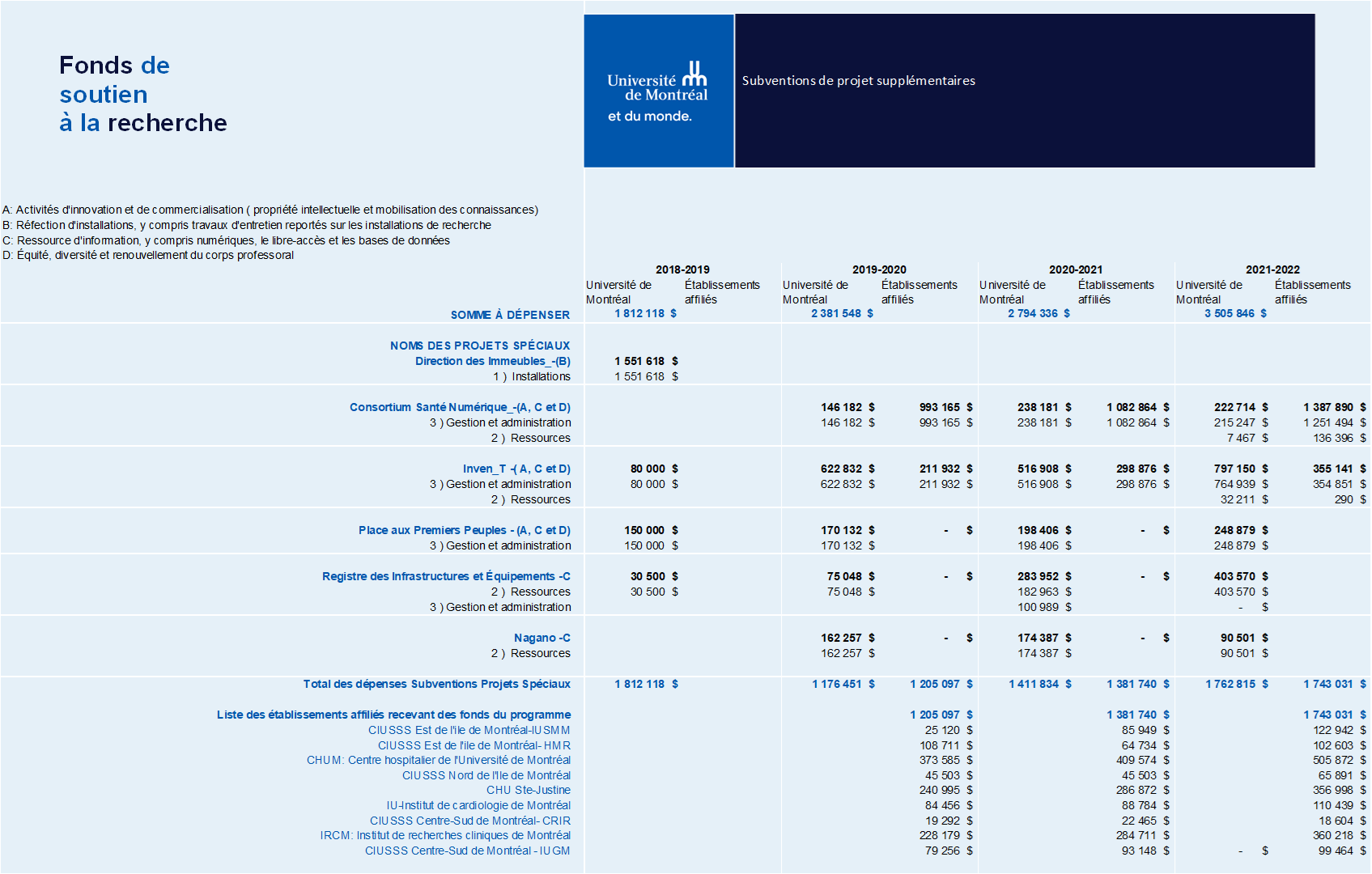
At the Université de Montréal, from 2019-2020 to 2021-2022, a specific choice to pool resources has led to the establishment of 3 priority projects resulting from the work of the Laboratoire d’Innovation of the Vice-Rectorate for Research and Innovation:
Projects at UdeM have also received funding from this program to serve the research community:
Registre d’Infrastructures et Équipements pour la recherche (RIÉ)
Funds invested in the RIÉ project correspond to targeted priority area C: information resources.
The funds invested in the NAGANO project correspond to priority target area C: information resources.
Results of 4 last years
 |
Applications submitted to the federal government
In 2022-2023 and for the years 2023-2024 and 2024-2025, the Université de Montréal and its affiliated centers have chosen to strengthen the activities of the
- Consortium Santé Numérique
by adding new components and setting up 3 other joint initiatives:
- Vers une Innovation Responsable,
- Plateformes écoresponsables en recherche et
- Actions Équité, Diversité et Inclusion.
These 4 projects build on the work of the previous wave, while responding to new emerging needs and setting new objectives to be achieved in an ever-increasing concern for training and raising awareness of current social issues. In addition, with the increase in the budget envelope for 2024-2025, a 5th project has been added: “Restructuring Research Support Services to enhance support for innovation and the valorization of research”. You will find here, the application submitted to the federal government.
See the applications (in French) : 2024-2025 Bonification, 2022-23, 2023-24, 2024-25, 2025-26
Incremental Project Grants - National Security Component
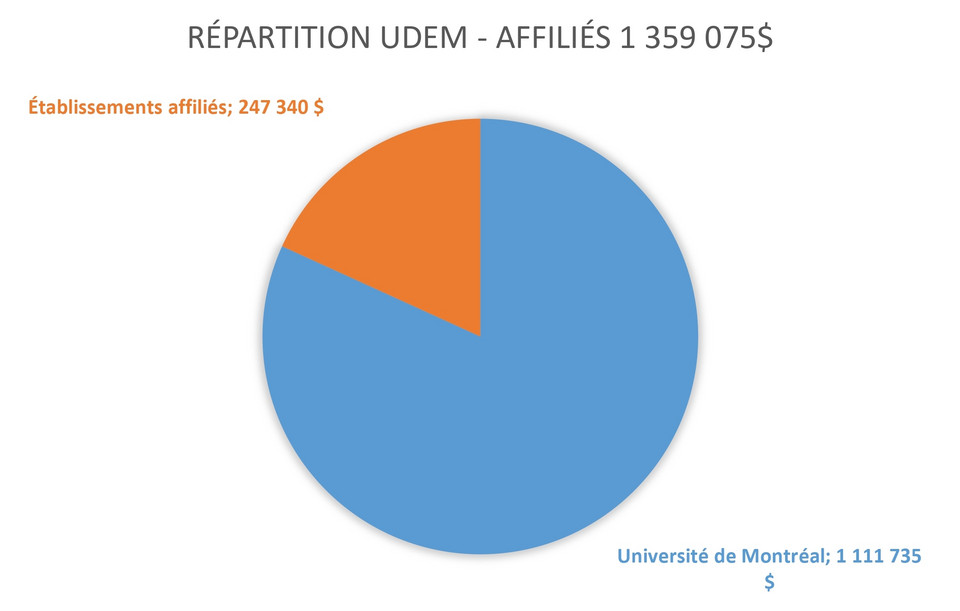
Since 2022-2023, the Canadian government has been funding a national security component of the Incremental Project Grants (IPG) program, through the Research Security Fund. These funds aim to enhance research security in Canada so that research institutions, such as the Université de Montréal and its affiliated centers, have the tools and knowledge they need to protect the work of their research teams.
(Please note that the graphics in this section are in French)
Financial year 2024-2025
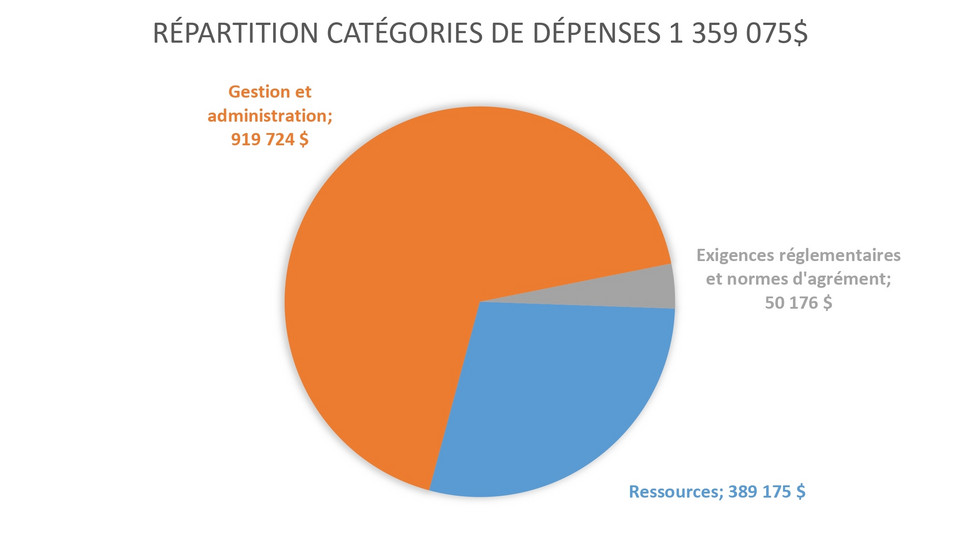
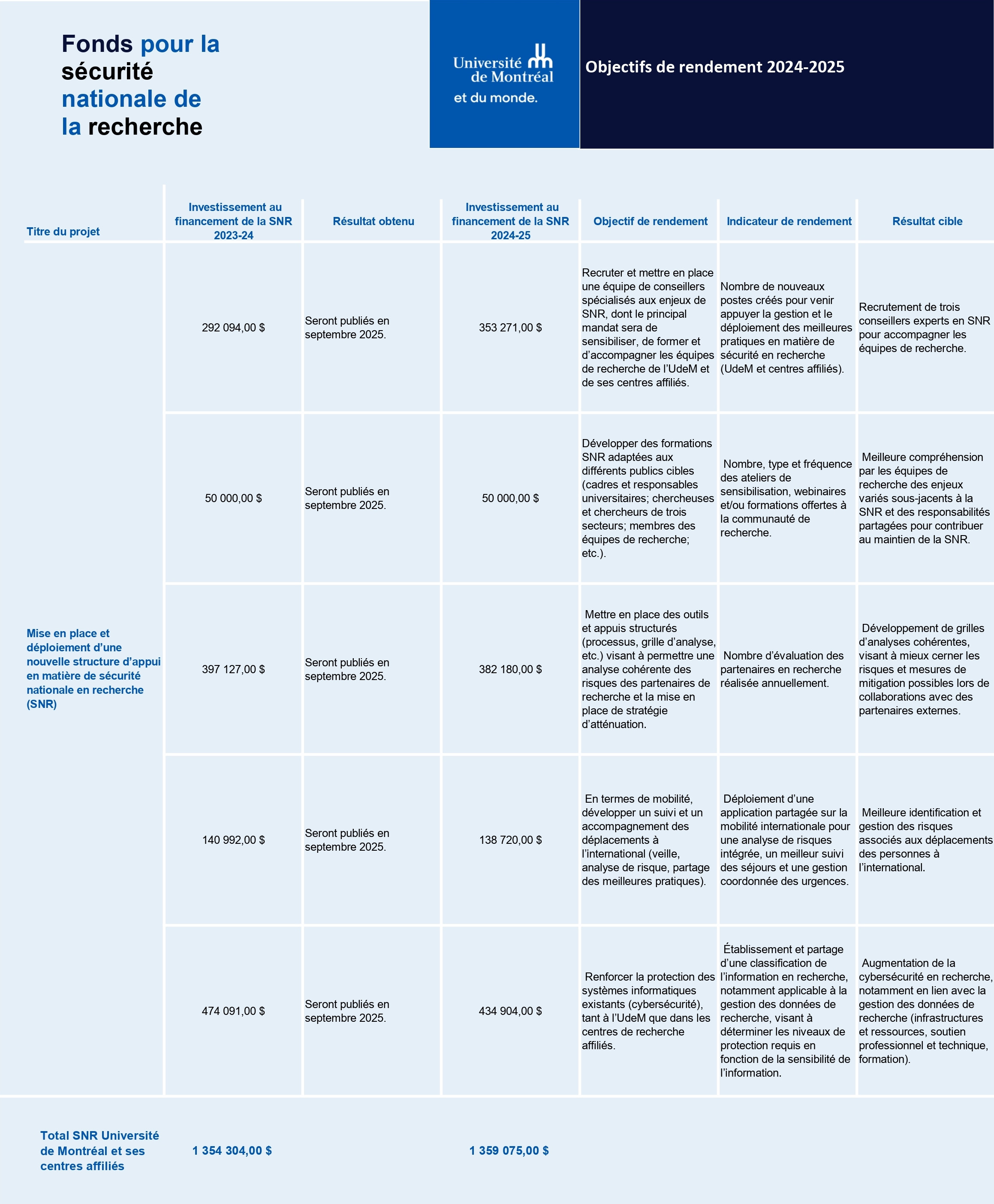
Performance targets for 2024-2025
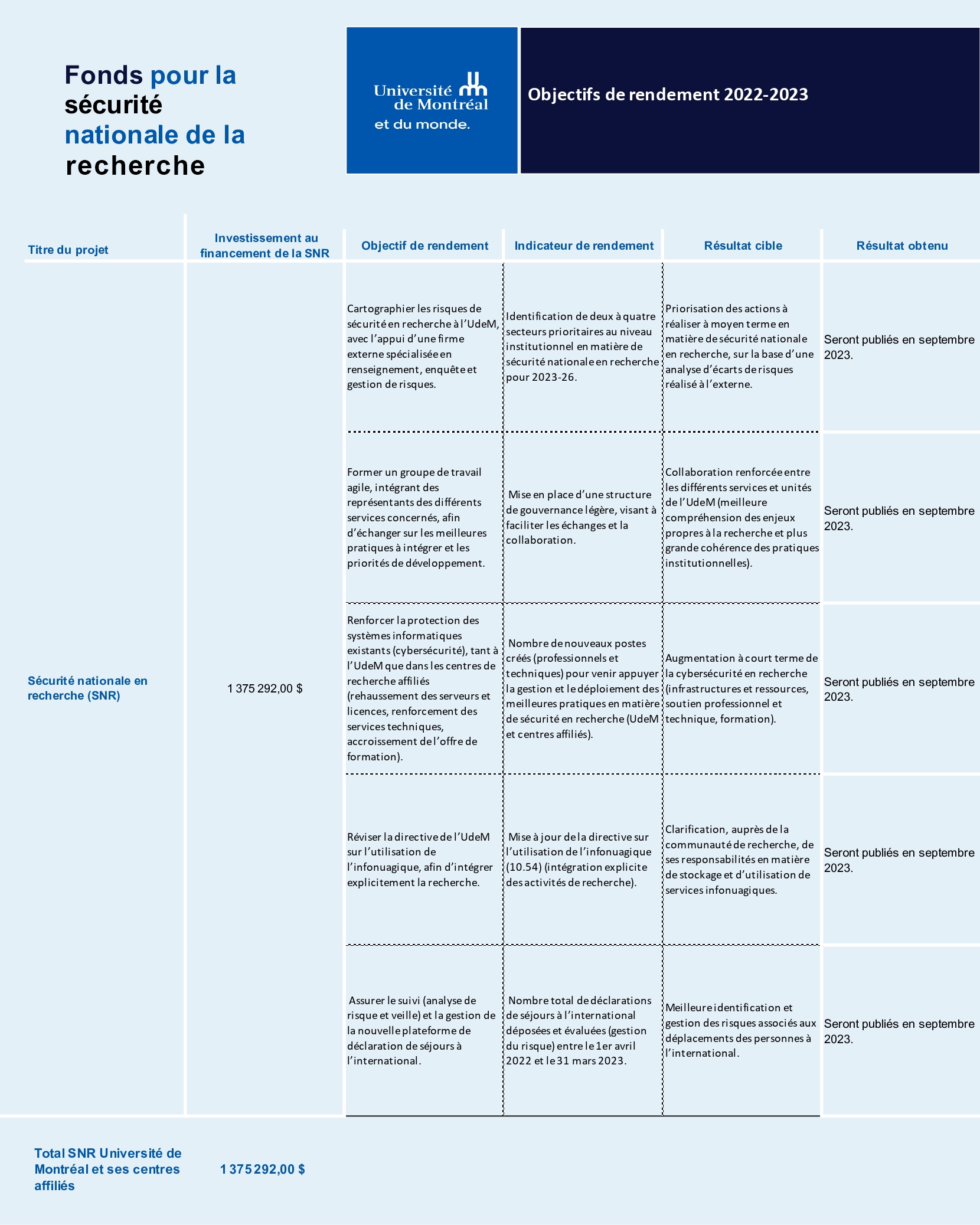
Consult previous performance targets (in French) : 2022-2023
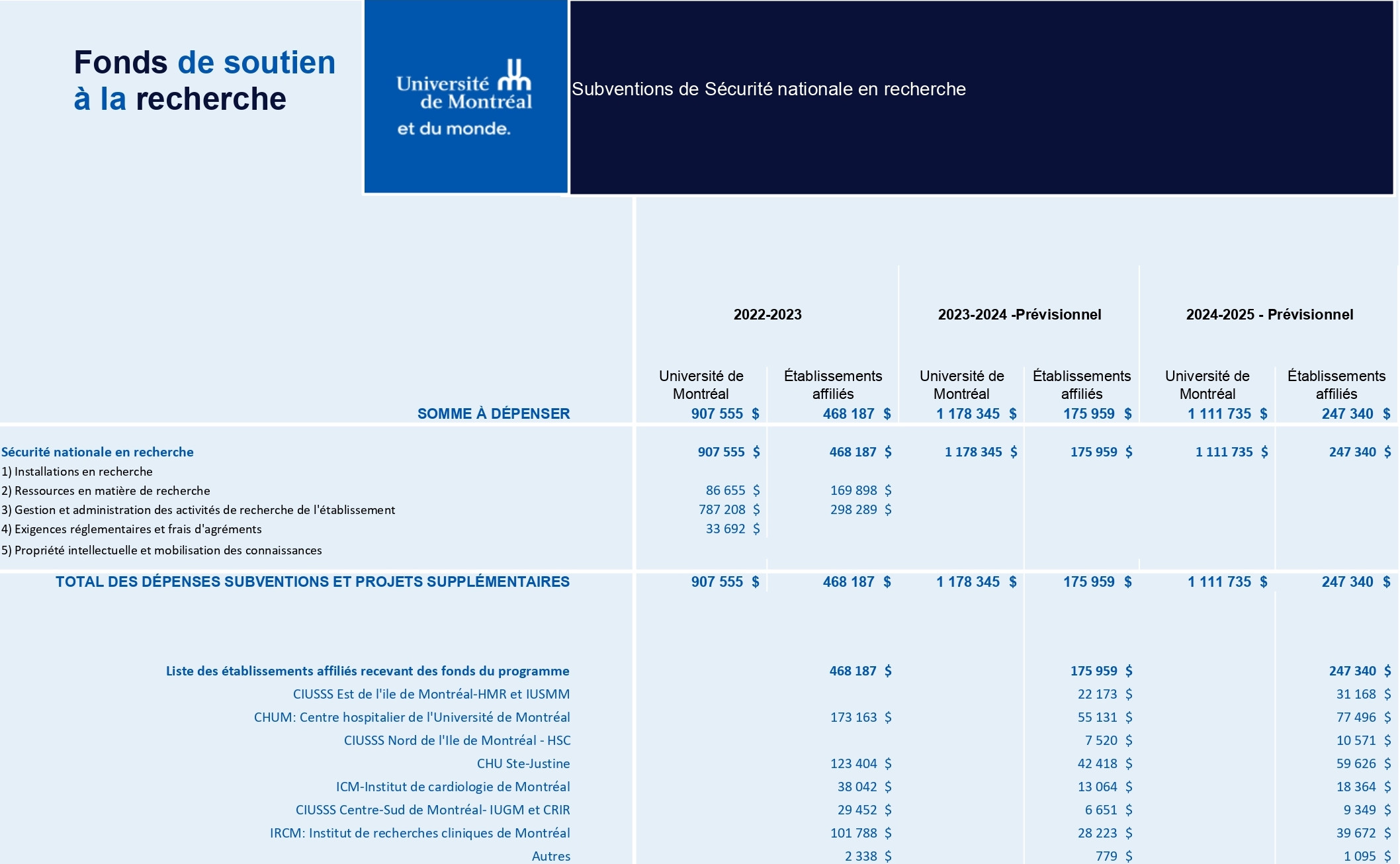
Previous and planned uses in 2024-2025
2023-2024 Performance targets

2023-2024 Results and performance targets
Applications submitted to the federal government
The Université de Montréal has submitted a request in 2023-24 for a total of $1,354,304. Over the next three years (2023-26), the Université de Montréal aims, thanks to this annual support, to set up a consulting services team, whose main mandates will be to raise awareness, train and advise the research community on best practices in national security. The measures deployed through the SPS program will strengthen and enrich cross-functional support mechanisms, through the implementation of concrete actions (policies, advisory services, tool development, webinars and training, etc.); all of which will be carried out with the support of the entire UdeM community, including its vast network of affiliated research centers.
See applications (in French) : 2022-23, 2023-24, 2024-25, 2025-26

Questions?
Administrative Director, Research Support Services
Bureau Recherche Développement Valorisation
Tél. : 514 343-6153